

How To Draw An Eye For Beginners
In this lesson, we'll have a expect at how to draw an eye. Nosotros'll cover drawing eyes from both a frontal view too every bit a side view (or profile) with graphite pencils and besides white charcoal. Three step by pace examples are included, and so be sure to scroll downward to run into them all.
The eye has been said to exist "the window to the soul". Sometimes we can look at just a person's eyes and know exactly who they are.
The process is fairly straight-forward. After drawing out the bones contours, we'll gradually develop the tonal range of the center. To create the representational effect that we're after, we'll gradually build upward layered applications of graphite to develop the value and the texture.
Drawing Optics with Pencil
This lesson is focused on teaching you how to draw optics with graphite pencils. Of grade, the approach that you accept is different according to the medium that you choose to use.
If you'd similar to have a look at how this process is different using unlike mediums, then the post-obit lessons may be helpful...
- How to Describe an Eye with Colored Pencils
- How to Draw an Centre with Pastels
- How to Paint a Realistic Eye with Oils
If realism is your goal, and so patience must be skillful. Just similar other art-making mediums like colored pencils or pen and ink, graphite applications must be patiently layered and deliberately practical.
Textures develop through layered applications of graphite of varying hardness. Harder pencils, which produce lighter marks, are practical first. Softer pencils are applied on summit, pushing values darker. If the softer pencils produce unwanted textures, and then additional applications of harder graphite can be applied, working the fabric into the tooth or texture of the newspaper.
Materials For This Lesson
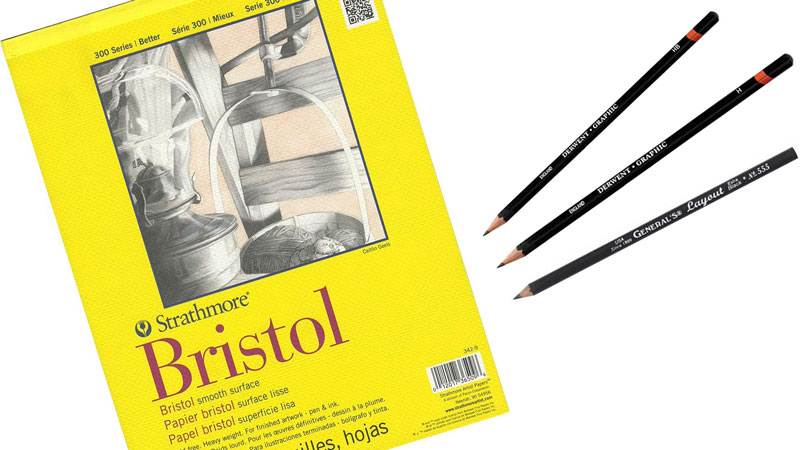
For this drawing lesson, a series of graphite applications are patiently applied on smoothen Bristol paper. This surface creates smoother transitions of value, but hands smears.
How to Describe an Heart - Step past Step
Here are the steps that we'll take to draw a realistic eye. Each stride is broken downward in more than depth beneath. It's important to be patient - creating a realistic illusion takes time...
- Draw the contours (outlines) of the center.
- Shade the iris and pupil.
- Shade the whites of the eye, tear duct, and eyelid.
- Develop the skin texture around the eye.
- Draw the eyelashes.
Step 1 - Draw the Contours (Outlines) of the Eye
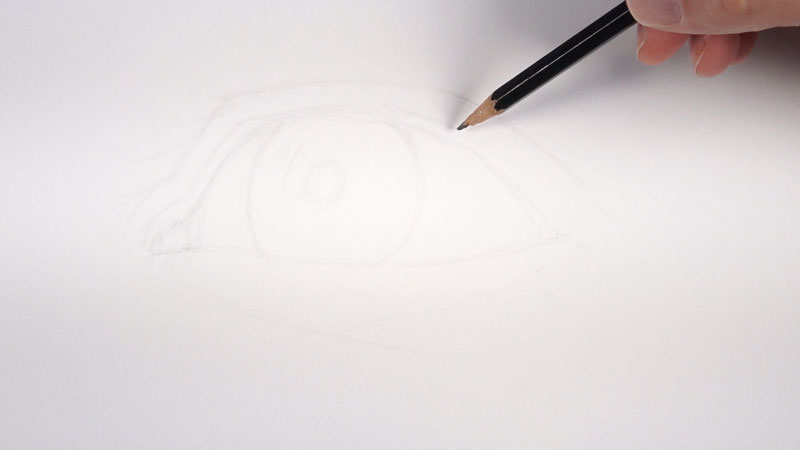
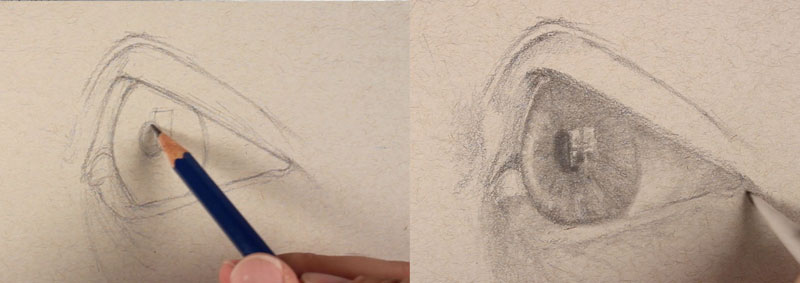
We'll begin the cartoon by lightly and loosely drawing the profile lines of the upper portion and lower portion of the shape of the eye, leaving open the location of the tear duct. We'll commencement with the "H" pencil with very niggling pressure. Within this shape, we'll draw the shape of the iris, pupil, and a shape for the strong highlight that overlaps the student slightly.
It'south perfectly acceptable to draw with many calorie-free lines at this phase. We'll progressively place heavier pressure level on the pencil every bit the cartoon develops, which will lead to darker marks and values. Be patient and focus on capturing the shape of the eye.
Step two - Shade the Iris and the Pupil
Next, we'll brainstorm the boring process of layering values, starting with the darkest values inside the pupil. Care is taken to preserve the highlight as darker tones are developed. This highlight will create the illusion that the eye is wet, so it's very important to preserve this expanse. It's much harder to get back and erase out a highlight when working with graphite.
The student will somewhen exist the expanse of darkest tone inside the cartoon. Nosotros'll slowly build up the dark values here. Past slowly layering darker applications, we have greater command over the values produced and nosotros can potentially avoid "graphite shine". Graphite smooth happens when heavy applications of graphite are practical and flatten the molar or texture of the paper, resulting in a very shiny surface area of graphite.
Within the iris, marks are made radiating from the center. While most of the darker marks are linear, a few course organic shapes. By gradually adjusting the values in this area, we can begin to create a more realistic appearance. The iris is actually made upwards of ii closely layered sections - the stroma and pigmented epithelial cells underneath. By gradually adjusting values, nosotros can develop a subtle, three-dimensional appearance.
The outer and inner portions of the iris are developed with slightly darker values.
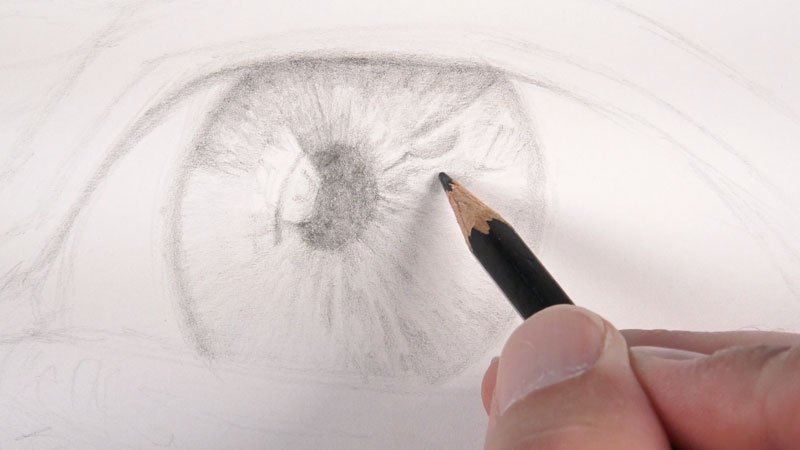
While the "H" pencil lays the background, we'll need to start pushing the values darker. A slightly darker and softer "HB" pencil is applied to progressively darken the values in the educatee and the surrounding iris.
In whatever eye that you depict, at that place will exist inconsistencies and unusual shapes. You may detect small spots of darker tones or wavy lines. Nosotros'll need to include these details in society to create a drawing that is realistic. Nosotros'll begin to develop these "imperfections" with the HB pencil over the lighter H applications already in place.
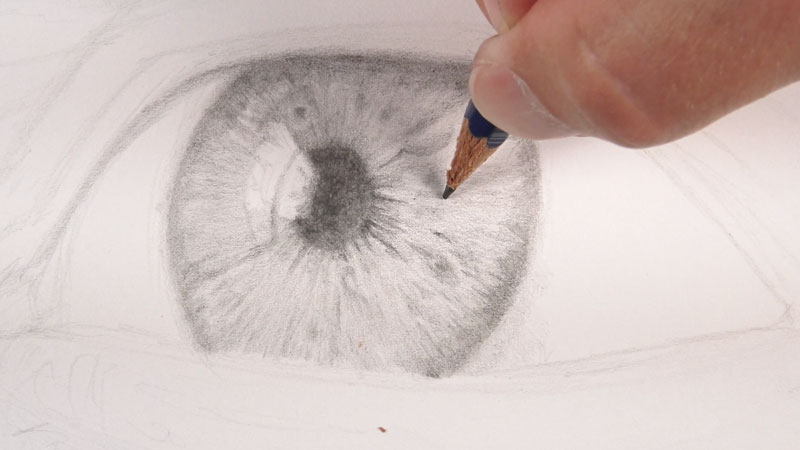
The texture of the iris is smooth and this should be reflected in our cartoon. Although the surface of the paper on which nosotros're working is already very smooth, the texture of the newspaper is still axiomatic. This means we'll need to alter the graphite applications to create a more than natural illusion of texture.
A blending stump is gently used to soften the texture. The blending stump is pulled in the aforementioned direction as the strokes fabricated with the pencil to preserve the design of lines and shapes within the iris.
After the blending stump has been practical, you may find that the contrast betwixt the values has been muted slightly. If this is the example, you tin revisit the iris with the HB pencil and restore some of the contrast lost. Doing so will but create additional depth to the cartoon.
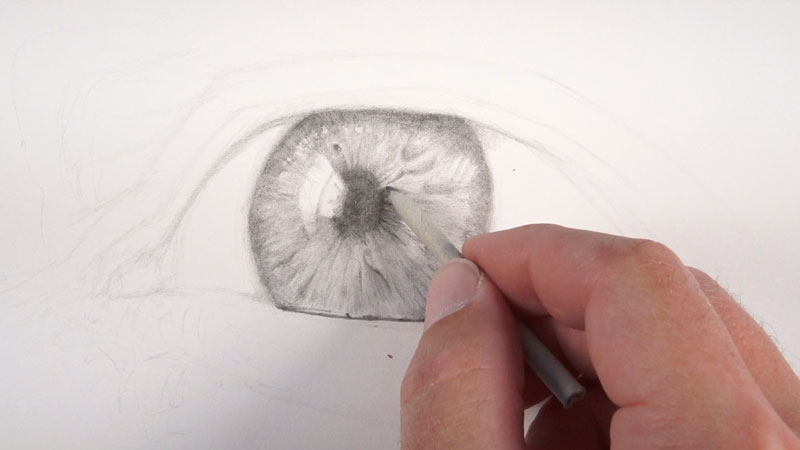
Now that we have a base of operations application of lighter graphite in place, we can switch to a darker graphite pencil. In this instance, a General's Layout pencil is used. This pencil is equivalent to a 4B pencil in darkness - even so, it is relatively hard, meaning that information technology keeps a sharper betoken for a longer period of time.
Nosotros'll then continue to slowly build up darker values with the darker pencil, making sure that we continue to preserve the potent highlight that overlaps the iris and the pupil. As we continue to develop the darker tones, the contrast and range of value increases in the drawing.
Step 3 - Shade the Whites of the Heart, Tear Duct, and Eyelid.
Afterward concealment the values of the pupil and iris a scrap further with the darkest graphite pencil, our attention at present turns to the other areas within the eye. A gentle awarding of the "H" pencil is applied to the "white" of the eye on the correct side. Remember, the eyeball is a sphere. This means that the values will exist slightly darker on each edge of the eyeball. In this example, we see that the shadow is rather strong on the right side, since the light source is originating from the left.
The tear duct is also darkened, leaving hints of lighter value within. This area is also wet, and the preservation of stiff highlights hither volition help to create this illusion.
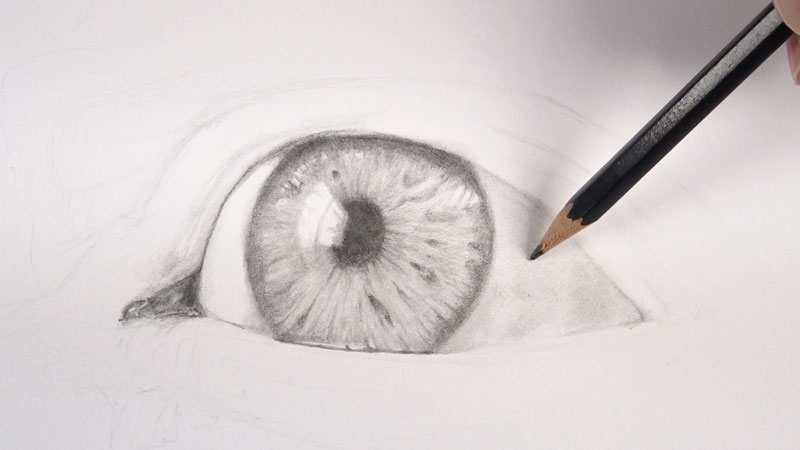
The summit eyelid overlaps the eyeball. In virtually cases, the light source originates from higher up, producing a shadow merely underneath the eyelid. A cast shadow tin also be found on the eyeball, but underneath the eyelid.
The underside of the eyelid is darkened and the crease to a higher place it is enhanced. The same process of layering graphite applications is followed - "H", "HB", and "Full general's Layout Pencil". Every bit graphite is added, we can blend applications with the blending stump, softening the texture.
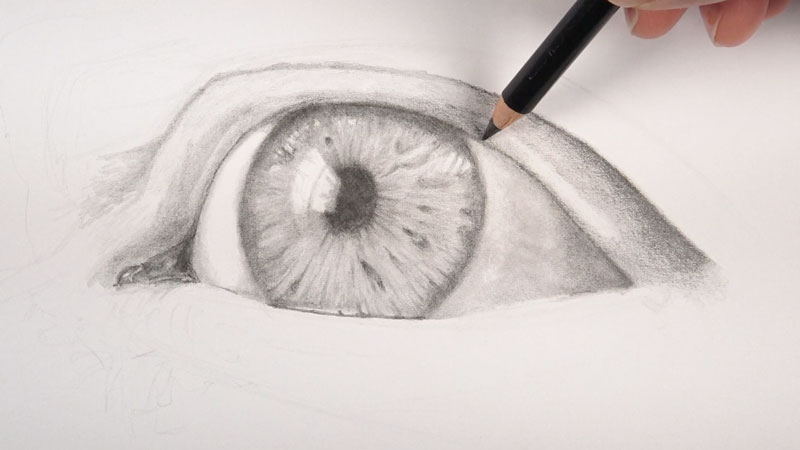

Footstep iv - Develop the Peel Texture Around the Eye
A few visible wrinkles are added on the left side of the upper eyelid crease, earlier adding a light application of graphite on the peel below the eye. The textural development of the skin underneath begins by making small shapes, isolating subtle areas of lighter value.
As we have thus far, we'll slowly build upward applications to progressively make the values darker and build up the illusion of texture. A low-cal awarding of graphite is applied here with the H pencil.
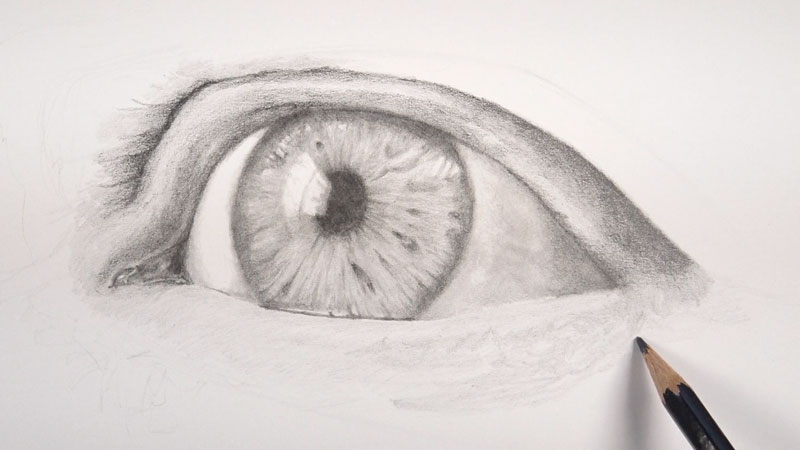
The contrast inside the areas of skin texture is enhanced by progressively making the shapes a bit darker with applications made with the softer graphite pencils. With a slightly greater range of value, the texture of the skin becomes more realistic. As this happens, areas around the eye are besides darkened, resulting in more contrast between the centre and the pare effectually it.
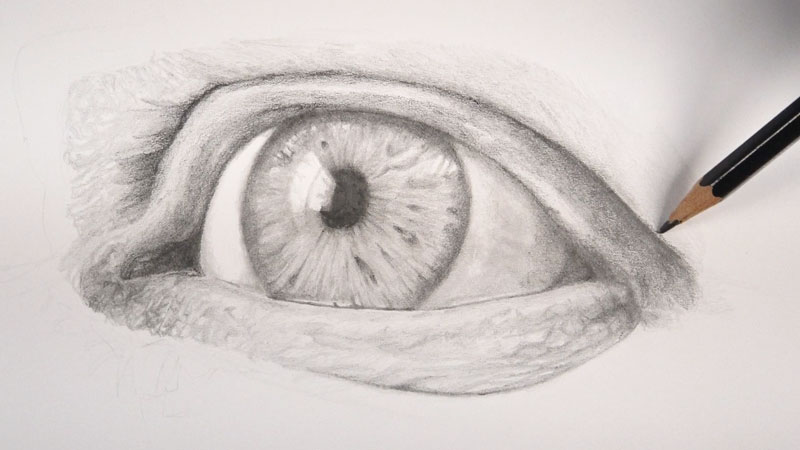
This process is repeated to develop the illusion of skin texture above the eye.
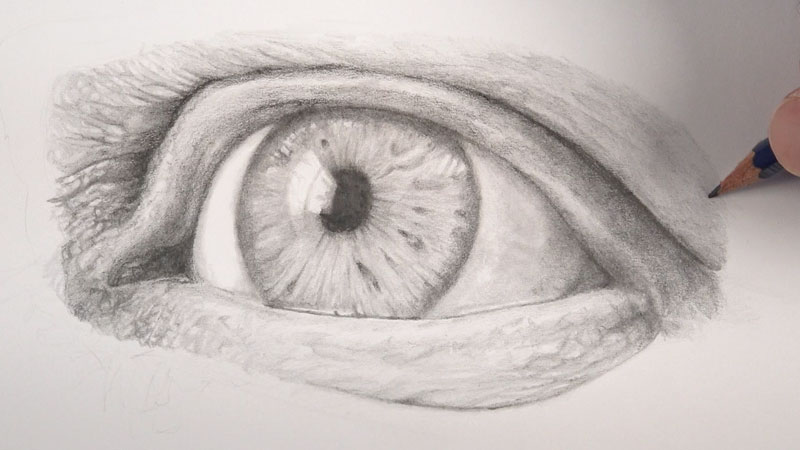
Step 5 - Describe the Eyelashes
With most of the layered graphite applications in place, we can add the eyelashes. With a sharpened "HB" pencil, assuming lines are pulled out from the skin. These lines mostly curve down and then upwards for the height eyelashes, with a few lashes angle in unpredictable ways. For the lesser lashes, the reverse is true. The lines are pulled upward and and then down. They are less concentrated than those found along the summit chapeau.
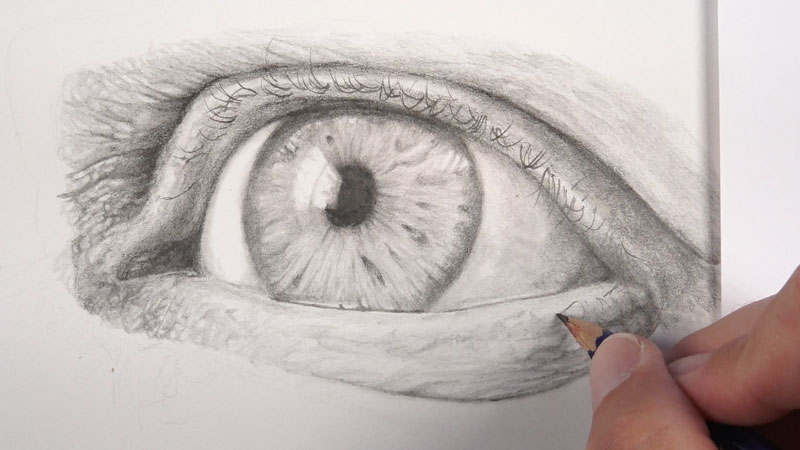
Using the "H" pencil, a few indications of veins within the middle are added to complete the drawing.
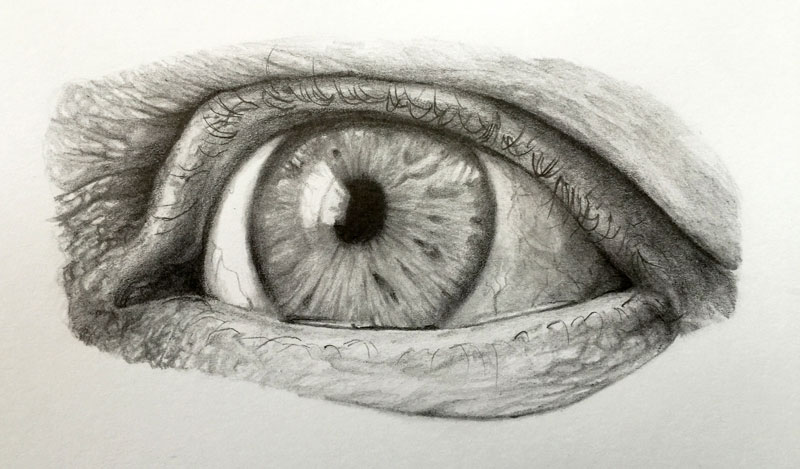
Draw an Center with Graphite and White Charcoal
Now that nosotros've had a expect at the nuts of cartoon a realistic middle with graphite alone, let'due south take a look at another case. In this second example, we'll once again draw an eye from a frontal view. The following examples come from the course, "Portrait Drawing the Smart Way". Check out the course for instructional videos and ebooks that intermission down the drawings in more depth.
The Advantage of a Toned Cartoon Surface
Before, we practical graphite pencils to a white surface. Considering we were adding night material to a white surface, we were constantly working to darken the values. Highlights were created past leaving the white of the newspaper "open", or past applying light pressure on the pencil before blending.
When graphite is practical to a white surface, we start at the superlative of the value scale (white). We then have to work the values towards the lesser of the scale in gild to create a full range.
This approach is perfectly acceptable, however you may find that working on a toned drawing surface gives you an advantage.
When nosotros work on a toned surface, nosotros can push button the value range in the drawing past starting close to a middle value. This means that we can use a white drawing medium to add together the highlights, instead of relying on the "white" of the paper. This approach allows us to push the values from the centre of the value calibration instead of working from one farthermost, like white.
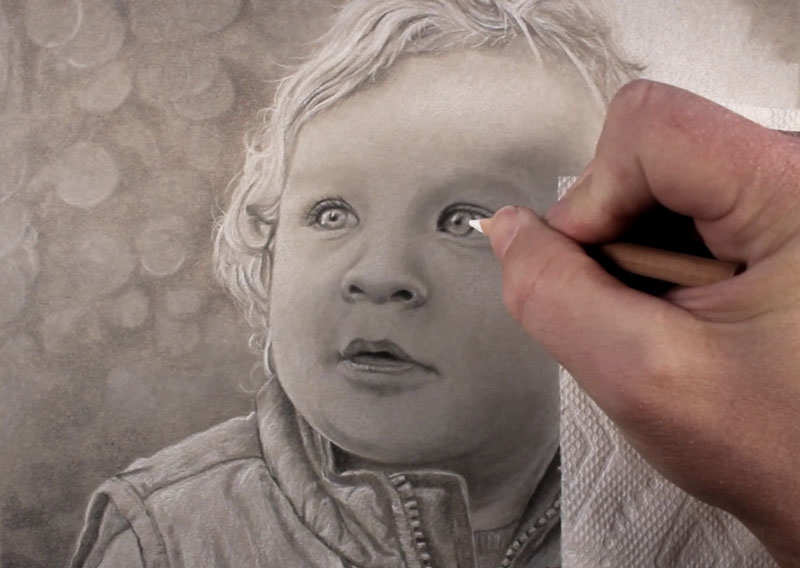
This is why many painters cull to apply a "footing" (a base color other than white) to an empty canvas. It provides a value or tone from which to begin piece of work. With painting, colors and values can be compared to the color and value of the ground equally they are added, assuasive the artist to make improve decisions most the values as they paint them.
On a gray drawing surface, we beginning with a gray "ground", much similar a painter may choose to do.
Identifying and Drawing the Contours of the Centre
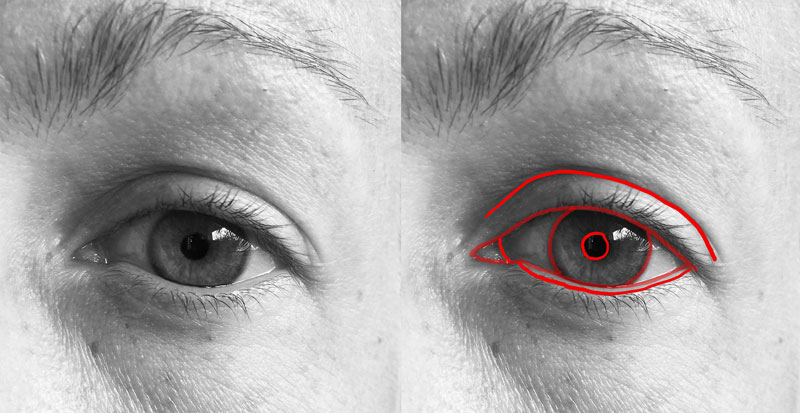
We'll start this drawing in the same way that we began the last. We'll first evaluate the contour lines or outlines of the eye. We'll look closely and written report the angles and curvature of each of the lines that should be included.
We'll too look for spacial relationships between the "whites" of the optics, the pupil, and the eyelids. By making comparisons, we can be more accurate with our initial marks.
Shading the Eye and Developing Highlights
With an agreement of the contour lines, we tin can begin to make marks with a light H graphite pencil. We'll draw the contour lines of the student, iris, and eyelids. We'll besides mark out a shape for the strong highlight. It is this highlight that will make the eye appear moisture.
To brand the values slightly darker, we'll switch over to an HB pencil. The pupil is usually the darkest area within the eye, only you may find that some shadows are besides rather dark. We'll gradually push the values darker. By progressively layering darker and softer graphite pencils, we have complete command over the values. We tin can e'er make values darker if needed - just if we get too dark, too rapidly, then information technology'south difficult to reverse.
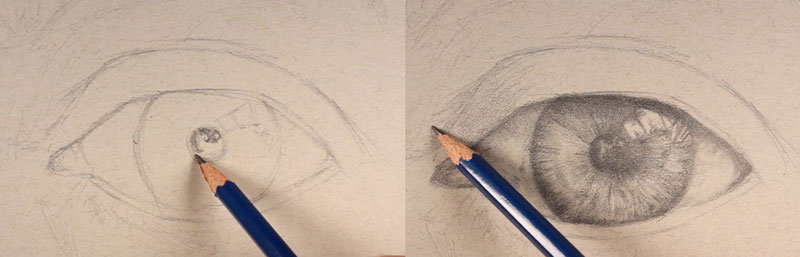
As we develop the darker tones plant within the iris, we'll pull strokes towards the pupil. The force per unit area placed on the pencil is varied in club to create variety in the tone. This results in a pattern that closely resembles the pattern of colour that we observe on the within of the iris.
To polish the application, a blending stump is used. Directional stroking is important with the blending stump. Strokes should be pulled in the same direction every bit the pencil applications.
After addressing the tear duct, we'll gradually work our way to the eyelid and surrounding peel with the HB pencil, blending applications as nosotros go. In this instance, the skin effectually the centre features a diversity of different tones and small imperfections. Nosotros'll vary the value in areas in order to create this illusion.
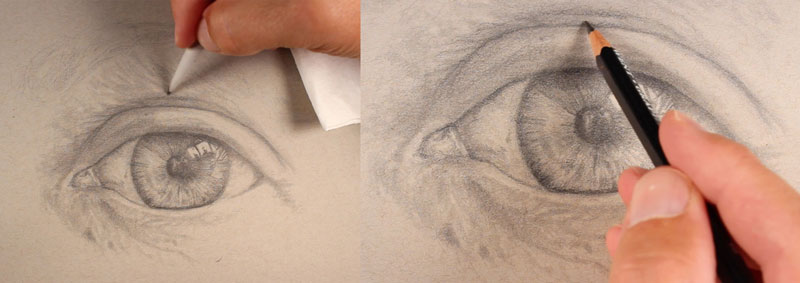
At this point, information technology'south time to start pushing the values fifty-fifty darker. We'll switch over to a 2B pencil, which is darker and softer than the HB. The pupil is darkened, over again leaving space for the stiff highlight. The darkest shadows nether the upper eyelid and the pucker created by the eyelid are darkened.
Since we're working on toned paper, we have the benefit of adding highlights with a white drawing medium. In this instance, a white charcoal pencil is used since it can be blended with a blending stump. The strongest highlight on the middle is addressed first, applying heavy force per unit area on the pencil. Then with lighter pressure, nosotros tin begin addressing the areas that are lighter in value, including the "white" of the eye.
Just as we did with the graphite applications, we'll blend the white charcoal applications with a blending stump. Not only does this eradicate some of the texture produced past the paper, merely it helps to create transitions of tone betwixt the darker areas and lighter locations. The stiff highlight in the eye is not blended since we desire this expanse to remain strong.
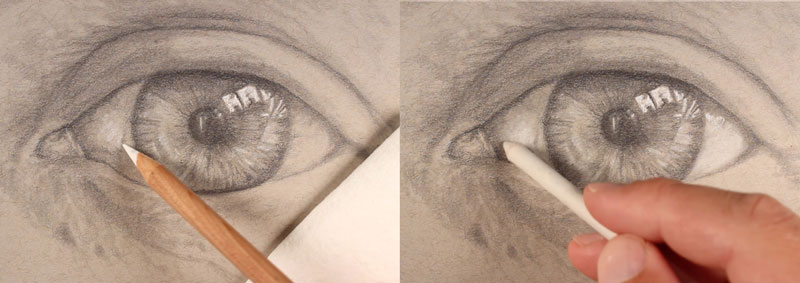
Now nosotros'll bring some of the white charcoal to the skin around the center and gently blend the cloth with a blending stump.
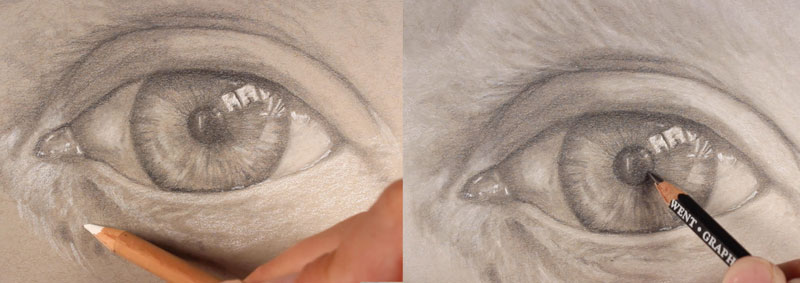
We'll also add some of the potent highlights that occur on the bottom eyelid. Just as the highlight added inside eye made information technology appear moisture, these highlights serve the same purpose. To ensure the highest level of dissimilarity, we'll avoid blending these locations with a blending stump.
So, with our initial highlights in identify, nosotros'll switch to an fifty-fifty darker, 4B pencil. We'll begin pushing the contrast, starting with the darkest locations in the pupil.
How to Draw Eyelashes
Once we've established some of the darkest tones, nosotros're gear up to draw the eyelashes. This part of the process tin can seem intimidating since we'll brand marks over portions of the centre and the surrounding skin. Still, there is a method that we tin can use to ensure that our eyelashes appear realistic.
This method involves thinking of the eye every bit quadrants. By dividing the eye into four quadrants, we tin brand decisions concerning the direction of the strokes for each eyelash and the direction of these strokes.
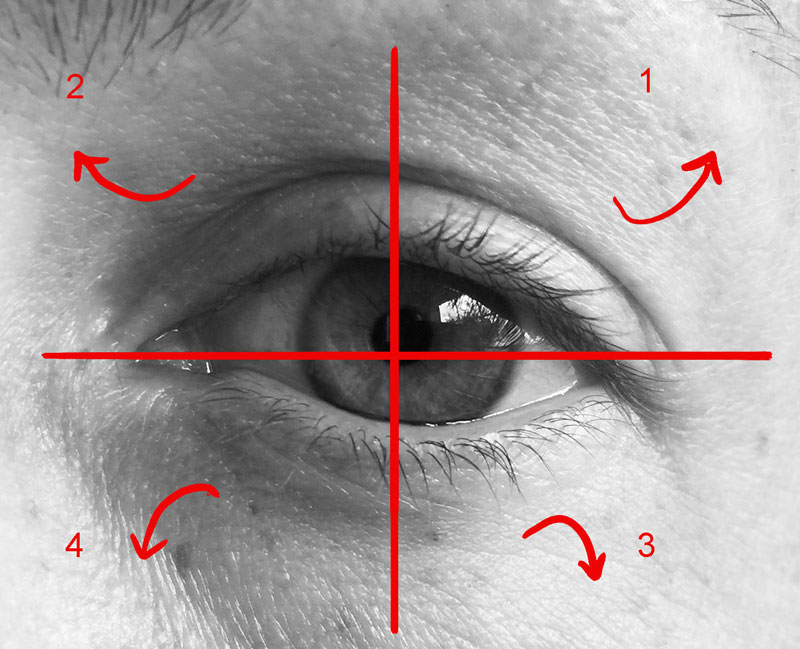
In quadrant 1, we should wait to see the longest and darkest lashes. Stokes made in this quadrant will dip down before extending back up and to the correct. The eyelashes are the nigh dense and frequent in this quadrant.
As we near the center dividing line, the strokes begin to become more vertical.
Quadrant ii has the second most number of eyelashes. In this quadrant, the strokes dip downward before extending back up and the left.
In quadrant iii, we see less eyelashes. They are more than sparse and much shorter. We can frequently detect a spacing created past the lower eyelid of bare peel. The eyelashes in this quadrant bow upwardly slightly earlier extending downward and slightly to the right.
Quadrant 4 has the least corporeality of lashes and in some cases, yous may notice that this expanse is completely void of any eyelashes at all. Eyelashes that you find in this quadrant bow upwards slightly before descending and slightly extending to the left.
Past breaking down the eye into four quadrants, we tin can approach the process of drawing the eyelashes with more confidence.
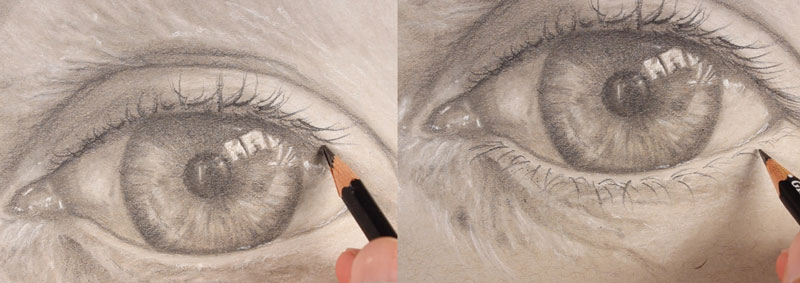
Find a identify to begin that's comfy for you. In this case, we'll start near the center, in quadrant 2, pulling strong strokes downward and slightly to the left. Nosotros'll gradually piece of work our way beyond the upper eyelid, using a sharpened 4B pencil. Vary the direction of your stroke, allowing it deviate slightly from the formula we discussed.
After working our way across the peak of the eye, we'll address the eyelashes found on the lower lid. Over again, we'll start on the left side, in quadrant 4. We'll work our way across, leaving a visible portion of peel between the eye and eyelash.
How to Draw Eyebrows
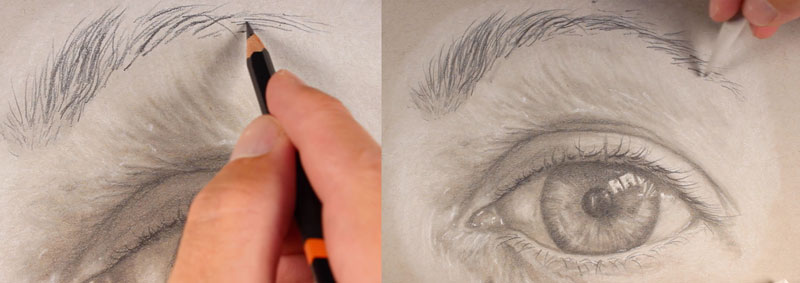
The eyebrows are simply smaller hairs that extend out from the skin above the heart. Simply like eyes, eyebrows come in many unlike shapes and sizes. It may be helpful to lightly draw the shape of the countenance earlier drawing any of the actual hairs. After defining the shape, we can make deliberate strokes with a sharpened 4B pencil, pulling out each stroke.
Closer to the bridge of the nose, these strokes may be nearly vertical. As the eyebrows extend outward, the hairs usually become longer and more horizontal. Once more, we'll vary the stroke. Some marks should exist darker and thicker, while others could exist slightly thinner and wispy.
Softening the strokes with a blending stump makes the eyebrows announced more than realistic. Just every bit we did before, strokes made with the blending stump should flow in the aforementioned management as the pencil marks.
Finishing Touches
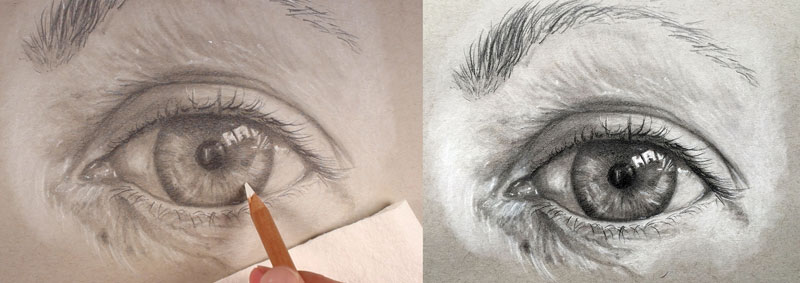
Now we'll complete our second drawing by adding a few additional highlights with the white charcoal pencil. We may choose to strengthen the highlights in areas to increment the dissimilarity and augment the range of tone.
We can also wait for opportunities to make the values darker in areas. We tin revisit areas such as the student and shadow under the eyelid with the 4B pencil. We'll proceed to button the relationships of the highlights and shadows until we're satisfied with the range of value, dissimilarity, and texture.
How to Draw an Heart from a Side View (Contour)
We don't always see the middle from a frontal view. In fact, in many portraits, the eye is positioned in a different place depending on the bending. For this reason, we'll take a slightly dissimilar approach. The steps involved are like, simply slightly dissimilar.
Using a Mini-Filigree
To amend understand the positioning of the contour lines, it may be helpful to sub-sect the subject into a mini-filigree. You can practise this by only drawing two intersecting lines over your reference photo. Draw a vertical line then that it overlaps the pupil. So describe a horizontal line from i corner of the eye to other. Depending on the angle of the eye, you may be left with a skewed filigree. This is fine since you can still apply these lines to make comparisons, which is the purpose of the grid.
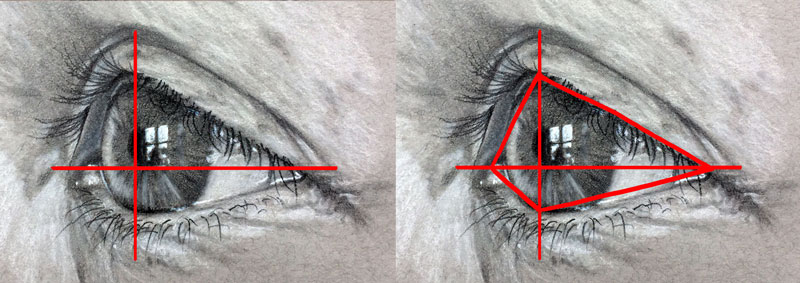
Using the intersecting lines as a guide, we can depict a few more straight lines to designate the outer edges of the middle. Diagonal lines are drawn from the top and bottom of the middle to each corner. Drawing the mini-grid is completely optional, but it may exist helpful if you notice it hard to locate the contours.
Now nosotros can brainstorm drawing the contour lines. Exist certain to draw shapes for the pupil, iris, tear duct and the strong highlight. Since the eye is viewed from an angle, the shapes of the pupil and iris will non be circles. Instead, these shapes are ellipses, which is a distortion of a circle.
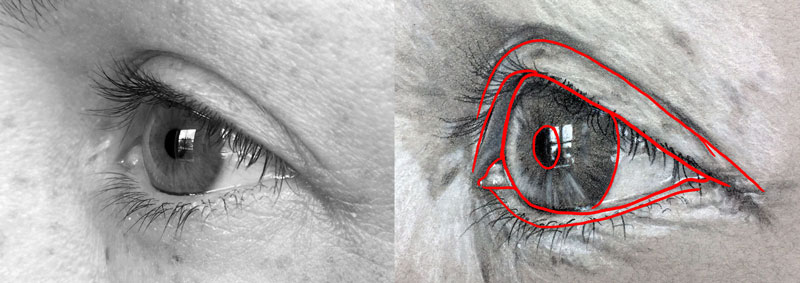
After drawing the profile lines with a light, H pencil, we tin can begin adding some of the darker values. Initial applications can be made with an H or HB pencil. Start in the locations that are the darkest, making sure to preserve the areas of strongest highlight.
For the patterns of the iris, nosotros'll again pull strokes from the pupil. In many cases, the tone becomes quite night effectually the outer edges. Y'all may utilize a darker pencil hither or simply apply more pressure. We'll also be sure to add a cast shadow underneath the eyelid. To eliminate some of the texture of the newspaper, we'll use the blending stump to smooth our applications equally we go.
With our initial darker tones in place, we can begin adding the highlights with a white charcoal pencil. We'll start with the potent highlight that overlaps the iris and the educatee, applying heavy pressure. Equally we did earlier, nosotros'll apply less pressure as we address the lighter values of the "whites" of the eye, the tear duct, and the surrounding pare.
Once more, the blending stump is used to soften the texture. To make the eye appear wet, additional strong applications of the white charcoal are applied to portions of the "white" areas along with a couple of marks applied within the tear duct.
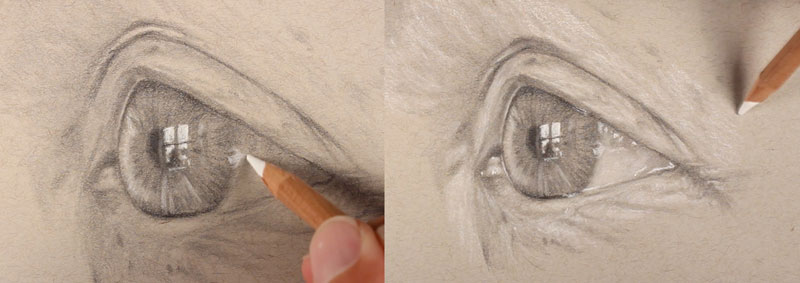
After adding the lighter values, we tin can go back with a softer 4B pencil and brand some of the shadows darker. This makes the highlights appear stronger since the range of value is increased.
At present we'll add together the eyelashes. We'll need to think about the angle of the eye in order to create convincing eyelashes. Logically, the strokes created for the eyelashes should dip downwards and extend back up slightly. But from this bending, you'll notice that some of the top eyelashes may not even make it back up to the eyelid. We tin can come across this in the image below. Discover how the elevation eyelashes on the correct side of the center just extend down and slightly to the right.
You'll also discover that we tin can see a scrap of the skin of the upper eyelid on the left side of the eye. In other words, the eyelashes extend out from the eyelid, non the eye itself.
In this example, nosotros can conspicuously see that this also happens for the bottom lashes. Over again, allow some diverseness in the strokes. Some should be longer, while others are shorter. The strokes should as well alter direction slightly.
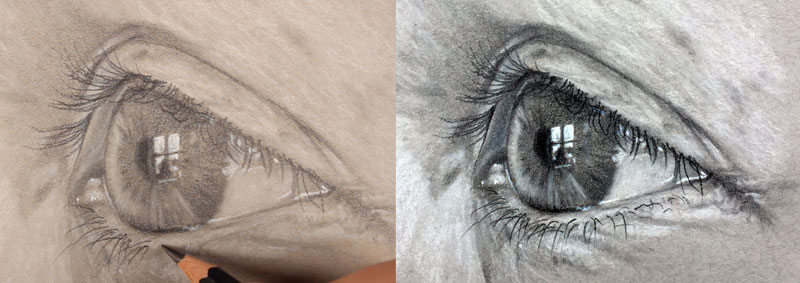
In gild to increase the dissimilarity, y'all may find that you need to revisit areas with darker and lighter applications to terminate the cartoon.
The Location of Eyes on the Face
Now that we've had a comprehensive wait at cartoon an centre, let'due south briefly discuss the location of the eyes relative to the head.
Since the eyes are conspicuously positioned on a face. You lot may check out this lesson on drawing a face...
- How to Draw a Face
It is oftentimes assumed that the eyes are positioned at the summit of the head. Instead, the optics are plant in the eye of the head. If we draw a line from the top of the caput (excluding the hair) to the bottom of the chin, we can expect to observe the eyes in the middle. This assumes that you're looking directly at your subject. If the head is tilted, or viewed from a dissimilar angle, then the positioning will also exist dissimilar.

The Size of the Optics
Just like with any of the other facial features, your eyes need to be proportional to the head. An easy way to ensure that your proportions are correct is to draw 5 light ovals that match the width of your eyes across the face from the terminate of one ear to the other. Nearly heads are approximately "5 eyes" wide. If you find that you tin can fit more ovals in this space, then your eyes may accept been fatigued likewise small. If y'all cannot fit v ovals beyond this width, then your eyes may have been drawn also large.
Last Thoughts on Drawing Eyes
1. Await at the eyes that you are trying to draw - I know - this tip seems pretty obvious. Just many people try to draw what they think they see, rather than what they actually see. Await at the shapes, lines and values and do your all-time to copy that info on your paper. Don't think about drawing optics, recollect nearly drawing shapes, lines, and values.
2. Remember that every heart is different - No 2 eyes will ever look the same.
3. Eyes are their ain unique shape - Optics are Non ovals and optics are NOT football shapes. They have their ain unique shape that you must recognize. (See tip #ane)
iv. Eyes have a total range of value - Nigh anything that you draw or paint should incorporate a total range of value. Eyes are no unlike. If y'all demand to employ a value scale to ensure that you have used a total range of value - then do it. The darkest darks and the lightest lights should all exist there.
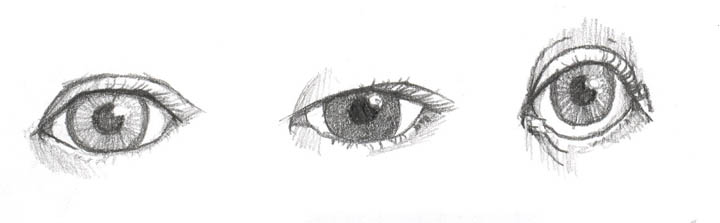
This lesson explored drawing a realistic eye with graphite pencils. And while many of the concepts that nosotros covered here carry over to other drawing mediums, information technology may be helpful to see how this process is slightly different when a different cartoon or painting medium is used.

Source: https://thevirtualinstructor.com/Graphiteeye1.html
Posted by: jacksonthly1979.blogspot.com
0 Response to "How To Draw An Eye For Beginners"
Post a Comment