

Windows Server 2012 R2 Vpn Client
Showtime published on TechNet on May 19, 2014
[This post comes to us courtesy of Md. Sabir Chandwale and Rituraj Choudhary from Global Business concern Back up]
In this post we will hash out about Virtual Private Network characteristic on Windows Server 2012 R2 Essentials.
Virtual Private Network can be straightforwardly installed and configured on a Windows Server 2012 R2 Essentials by running the Ready Anywhere Access magician and selecting Virtual Individual Network (VPN) choice on the following screen.
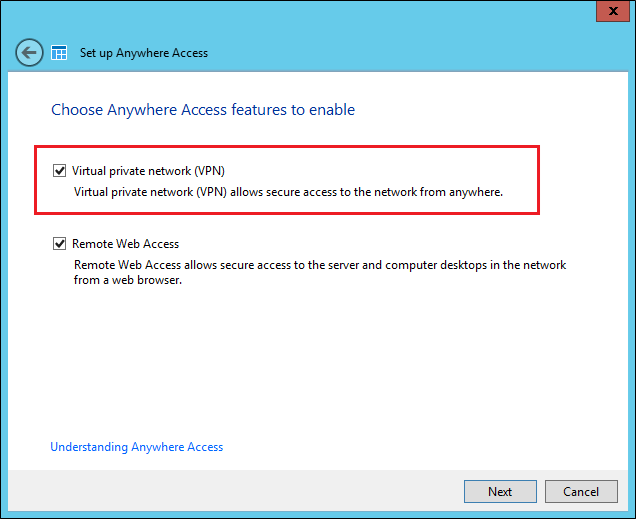
If yous desire to know near Remote Web Access, or run through the sequential screens of Anywhere Admission wizard, please visit this mail service .
When yous choose to enable VPN using this wizard, the following roles/features become installed on the Essentials Server: Remote Access, DirectAccess and VPN (RAS), IP and Domain Restrictions, IIS Management Scripts and Tools, Network Policy and Access Services Tools, and Windows Internal Database.
You tin can besides enable these roles/features from the Server Director or PowerShell command-lets, nevertheless on Windows Server Essentials we recommend enabling it using the Set up Anywhere Access wizard.
Information technology's noteworthy that Windows Server 2012 R2 Essentials allows client machines to join their server without having to exist within the company network using a feature called Remote Domain Bring together . So, if VPN is enabled on Server Essentials, you may connect a remote client to the local network via VPN, run the Connect magician from http:// <servername> /connect or http://< domainname >.remotewebaccess.com/connect URL and join the remote customer to the server. The process is very simple and straightforward.
As a prologue to talk over some common bug with VPN on Windows Server 2012 R2 Essentials, let united states of america first glance through the default Routing and Remote Admission (RRAS) settings. Y'all may also notice the specifics about these settings on TechNet .
Notation: Server Essentials automatically manages the routing for VPN, and therefore Routing and Remote Access (RRAS) UI is subconscious on the server to foreclose tampering of RRAS settings. As a effect, to view, change or troubleshoot the Remote Access settings, you need to install Remote Access GUI and Command-Line Tools using Server Manager or the post-obit PowerShell control:
Add-WindowsFeature RSAT-RemoteAccess-Mgmt
This characteristic enables Routing and Remote Admission console and respective command-line tools to manage VPN and DirectAccess. Notation that this role may not be required on the server unless you demand to change the settings for VPN or DirectAccess.
Default Settings of VPN on Windows Server 2012 R2 Essentials
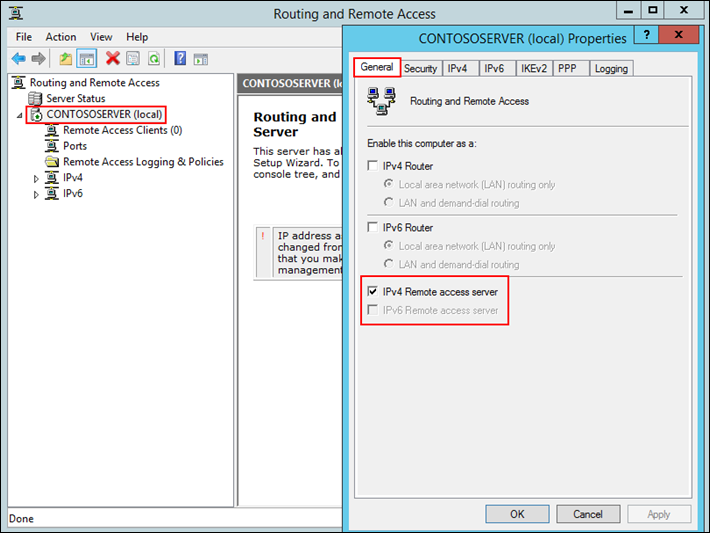
To cheque the default settings for the VPN, open up Routing and Remote Access Manager. Right click server name , and select Properties .
On the General tab, IPv4 must be enabled:
The Security tab consists of the Authentication Methods… and SSL Certificate Binding :
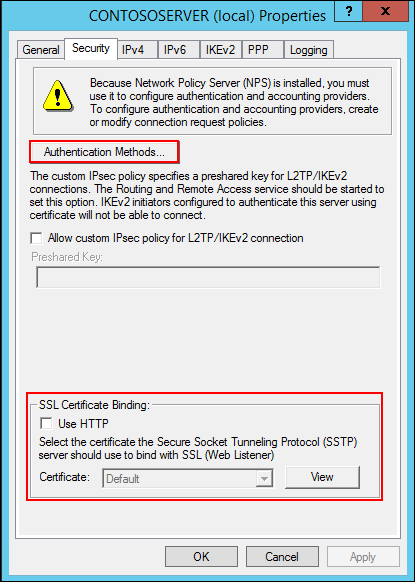
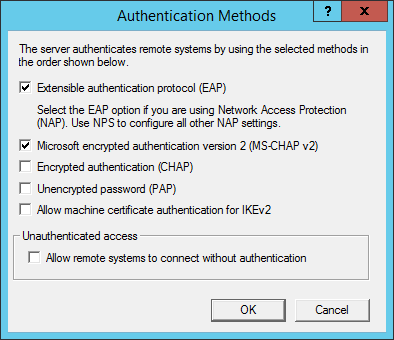
The Hallmark Methods should have Extensible authentication protocol (EAP) and Microsoft encrypted authentication version 2 (MS-CHAP v2) enabled. You tin can confirm it by clicking the Hallmark Methods… button on the Security tab.
The SSL Document Binding section on the Security tab displays the certificate active for VPN. This too indicates that we enable VPN on SSL and that you do not take to permit any port other than port 443.
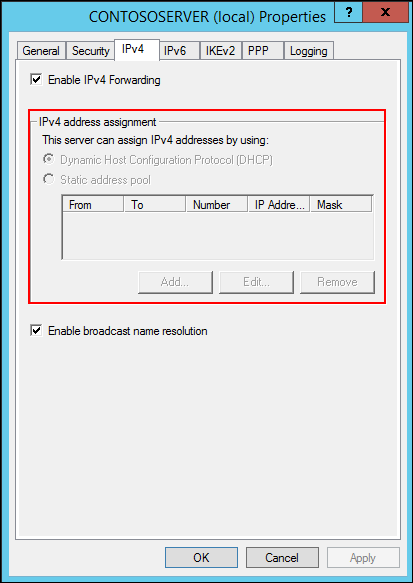
Let's movement on to the IPv4 tab. Past default the VPN clients are set to receive IP from DHCP, only you may crave to alter information technology to a Static address puddle for troubleshooting purposes.
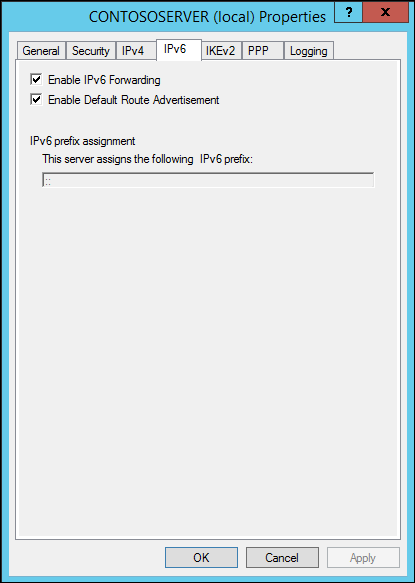
On the IPv6 tab, the options Enable IPv6 Forwarding and Enable Default Route Advert are selected by default.
The IKEv2 tab consists of the default options to command the IKEv2 client connections and Security Association expiration.

The PPP tab contains the settings for Point-to-Point protocol and are as follows:

The Logging tab on the server properties folio contains the level of logging enabled for Routing and Remote Access.

To enable additional logging for the Routing and Remote Access, select the option Log additional Routing and Remote Access information . One time this pick is selected additional log files are created in the %windir%\Tracing directory that provide deeper insight to troubleshoot RRAS issues. Make sure to disable the additional logging one time the troubleshooting is complete.
Yous may also gather and change information for Remote Access from an elevated Windows PowerShell terminal. Here are some common commands:
| Control | Purpose |
| Go-Command -Module RemoteAccess | Displays a list of commands bachelor with RemoteAccess module |
| Get-RemoteAccess | Displays the configuration of VPN and DirectAccess (DA) |
| Get-VpnAuthProtocol | Displays authentication protocols and parameters attack the VPN |
| Get-VPNServerConfiguration | Displays VPN server properties |
Hither is a sample output:

You can wait at the assist file of each of these commands for a detailed description. Amend yet, yous can use the following command to insert the assistance contents of each of these commands for the module RemoteAccess to a text file as:
$(foreach ($command in (Get-Control -Module RemoteAccess)) {Go-Help $command.Name} ) | Out-File HELP.txt
We will discuss some common problems with VPN on another post in hereafter.
Source: https://techcommunity.microsoft.com/t5/windows-server-essentials-and/understanding-vpn-configuration-in-windows-server-2012-r2/ba-p/398928
Posted by: jacksonthly1979.blogspot.com
0 Response to "Windows Server 2012 R2 Vpn Client"
Post a Comment